

I used to be more impressed by complicated productivity systems than I am now.
There is a certain appeal to them. The perfect notebook. The perfect app. The perfect set of tags, contexts, priorities, reviews, rituals, and dashboards. For a little while, it feels like progress because there is so much to adjust.
But a system is not the work. At its best, it helps you get back to the work with less friction. At its worst, it becomes one more thing asking to be maintained.
The simplest test I know is this: is the system helping me do something that matters, or is it giving me a more elaborate way to avoid deciding what matters?
Leverage, Not Ceremony
I still care about systems. A good calendar, a decent task list, and a regular place to think can save a lot of scattered attention. The useful question is whether the system gives back more than it asks.
Five minutes of planning before a messy task can be a good trade. It can prevent rework, clarify the next step, or help you notice that the task should not be done at all. That is leverage.
The opposite is overhead. Overhead is the time you spend feeding the system so the system can keep existing. Some of that is unavoidable. Calendars need updating. Notes need enough structure to be found again. Priorities change, and the list has to change with them.
The trouble starts when the maintenance becomes the center of gravity. You spend more time grooming the list than doing the work. You keep refining the categories because choosing the next hard thing feels uncomfortable. You feel productive because the system looks cleaner, even though the real problem has not moved.
The Smallest Useful Loop
If I had to reduce a productivity system to its useful core, it would look less like a dashboard and more like a loop:
- Choose something that matters. If that feels too large, choose one real next action.
- Work while the work is still useful. Not forever. Just long enough to make honest progress.
- Rest when rest is the better move. Tired work often creates cleanup work.
- Stop when the day has enough shape. Not every open loop deserves the rest of your evening.
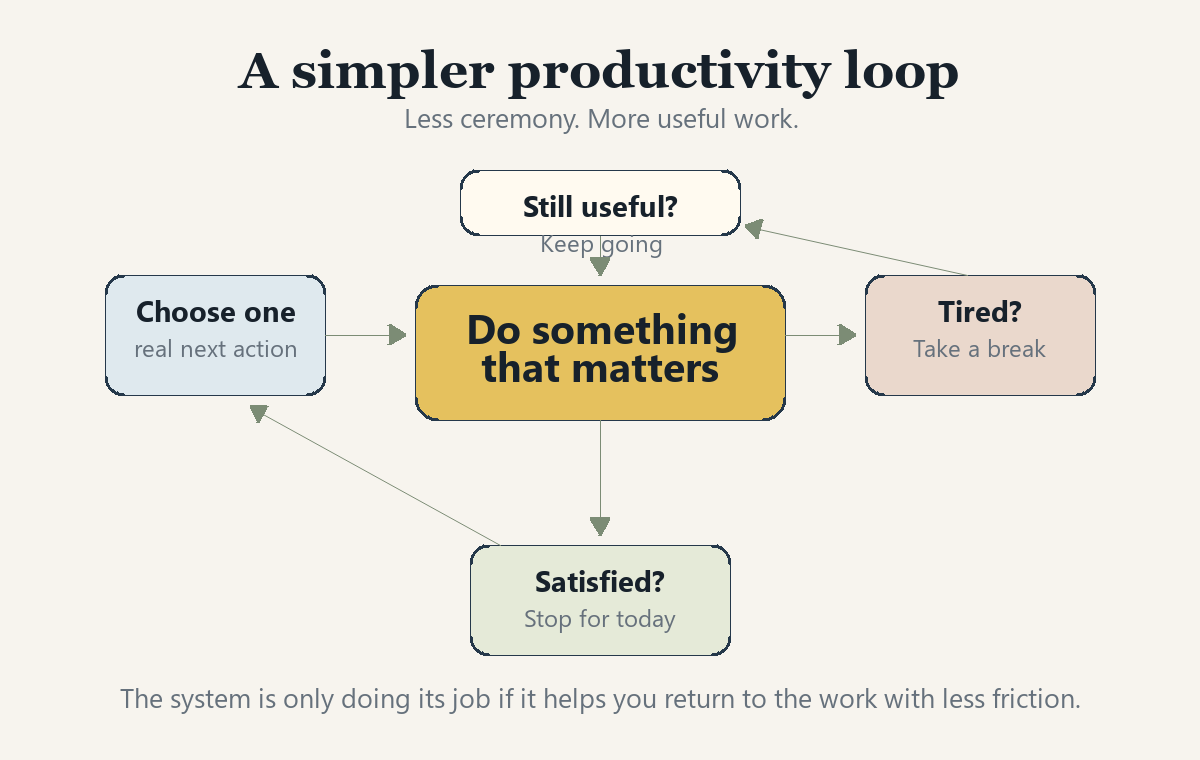
This is almost embarrassingly simple, which is part of why it is useful. The system should not need to be impressive. It should make the next good action easier to see.
When The System Is The Problem
The warning sign is not that a system has overhead. Every real system does. The warning sign is that the overhead no longer has a clear return.
If I am avoiding the task by reorganizing the task list, the problem is not that I need a better list. If I keep moving the same item from day to day, the problem is probably not the calendar. It might be unclear, too big, badly timed, no longer important, or something I have not admitted I do not want to do.
That is where a simpler system can be more honest. It gives you fewer places to hide.
At Present
I see the same pattern in team systems now. A planning ritual, issue board, status report, or dashboard earns its keep only if it helps people make better decisions and do the right work with less confusion.
Once the ritual starts existing mostly because the ritual exists, it is time to simplify it, change it, or let it go.
That is still the productivity test I trust most: does this help me return to something that matters?