

“What is important is seldom urgent and what is urgent is seldom important.”
Dwight D. Eisenhower
Tradeoffs and prioritization decisions are some of the most frequent and impactful responsibilities I have every day. When new asks come in, I need to think about the highest-leverage use of my day, week, and year. With a team, the same question shows up in roadmap planning, capacity conversations, and ad hoc partner requests.
Stephen Covey popularized the framing in The 7 Habits of Highly Effective People and First Things First: separate work by whether it is urgent, important, both, or neither. I initially applied it to my own personal prioritization, and I still find it useful that way. Unsurprisingly, it applies equally well to team-level priorities.
Urgency and Importance Defined
Urgency is how quickly action is needed. Urgent work often announces itself and demands attention: an incident, customer impact, a blocked partner team, a compliance deadline, or a decision that is holding up execution.
Importance is the level of impact and whether something contributes to the long-term goals of you or your team.
The ideal state is to be working on important tasks, and even more ideally, when they are not urgent. For example, someone who suffers a health scare may make their health a priority now, because health is both important and urgent once that occurs. However, ideally, if health is important to us, we would prioritize it earlier, before it becomes an emergency.
The underlying pattern is that it is risky if important work keeps getting deferred in order to make room for less important urgent asks. It is better when we are able to continually work on the important things before they become urgent.
Work on the important things before they become urgent.
The Urgency Matrix
The matrix helps me personally evaluate work, and is also helpful in shared decision-making with partners because it gives us common terminology. We may come to an agreement when we realize one request is urgent but not actually important, while another is important and deserves resources. If one of us thinks a project is important while the other person does not, that is also valuable information we can discuss.
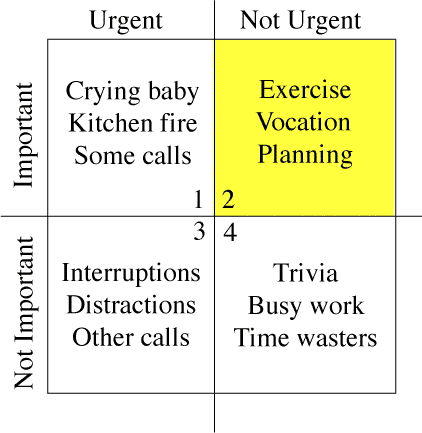
Let’s go over the quadrants one at a time.
- Urgent and important: real issues that need attention now, such as incidents, hard deadlines, customer-impacting problems, or blocked teams.
- Important but not urgent: work that drives long-term goals forward, such as planning, coaching, architecture, prevention, hiring, and relationship building.
- Urgent but not important: work that suddenly appears and may emotionally feel like an emergency, but has little long-term impact.
- Not urgent and not important: low-value activity that should usually be eliminated, reduced, or left alone.
The Work That Drives Long-Term Goals Forward
The second quadrant is the one Covey urges us to focus on: important, non-urgent work. That may not be where things start, especially if a team or a role is behind and dealing with many asks that are both urgent and important. However, if that is the starting point, the direction we want to head in is addressing the items that are both urgent and important as quickly as possible, while deferring or ignoring unimportant work, to get to a place where there is time to work on quadrant two work.
This is the work that compounds. In my own planning, it might be the habit I keep postponing, the relationship I need to invest in, the thinking time I need to protect, or the hard decision that makes everything else easier later. On a team, it might be architectural cleanup, coaching, documentation, incident prevention, roadmap clarity, or a project brief that gives everyone better context before execution begins.
Good leadership often looks like making time for the problem before it becomes dramatic.
That is why it is not enough to agree that something is important. If it never gets time on the calendar or capacity in the roadmap, then in practice we have not prioritized it. The stated priority and the actual allocation have to match.
McKinsey has made a related point about executive time: time management is not only an individual issue. Leadership attention has to match the organization’s priorities. I have found the same thing at the team level. The work we protect is a much stronger signal than the work we merely say matters.
Using The Matrix In Real Conversations
Company-wide prioritization is its own complex process, with tradeoffs across teams, customers, strategy, dependencies, and timing. Setting that larger machinery aside for the moment, the matrix is still useful because it gives leaders and partners a practical way to discuss whether attention is matching intent.
When a new request comes in, the conversation does not have to be vague. Is this urgent because a customer, deadline, or dependency genuinely needs action now? Is it important because it moves a meaningful goal forward? Is it both? Or is it a loud request that would displace work we already agreed mattered more?
Urgency should earn attention, not automatically outrank judgment.
I find this especially useful with partner requests. A partner team may be asking for something real, and I want to take that seriously. But taking it seriously does not always mean immediately saying yes. It may mean understanding the impact, naming the tradeoff, and deciding where the request belongs relative to work we already committed to.
For me, the matrix is less about sorting every task perfectly than noticing what keeps getting protected, postponed, or quietly displaced.
The urgent work will usually announce itself. The important work often has to be given room before there is proof that it needed protecting.