“Begin with the end in mind.”
Stephen R. Covey, The 7 Habits of Highly Effective People
Email, text, DMs…all of these are easy to send and surprisingly easy to make hard to answer. When someone is busy, there are two challenges that drive a response: first is getting their interest, which presumably you have. The second is, structurally, how difficult is it for that person to respond.
I think about this a lot from the receiving side.
On a normal day, I may be in back-to-back meetings with only a few minutes between them to skim messages and respond. If the ask is clear, I can often answer quickly. If the request is buried in a wall of text, I probably cannot give it the attention it deserves in that short break, which means it waits until later, when I have time to sit down and reconstruct what is being asked.
That delay is not always about priority or willingness. It’s purely about – was this easy for me to understand what was needed from me, and was it easy for me to respond.
Over time, I have found a few habits that make messages easier on the person receiving them.
Keep It Short Enough To Read Now
The longer a message is, the more likely I am to make a quick decision to come back to it later, especially if I cannot immediately understand the importance, urgency, or point of it.
That is not because I do not care. It is because a long message asks for a different kind of attention. If I only have two minutes between meetings, I can answer a clear question, but I probably cannot unpack a long thread, infer the real ask, and figure out why this matters to me and what is needed from me.
Give The Message A Shape
Beyond the length of the message, making it easy to skim and understand the ask is critical. A message that contains several questions, a few implied decisions, and background that may or may not matter is more difficult to read and takes longer to respond. Contrast that with this simpler structure:
A useful message usually has three parts:
A useful message makes the next action easy to find.
- What this is about.
- The context the person needs – no more, and no less
- A specific decision or request.
That does not mean every message needs to be terse. The message should be as long as necessary to get the point across, but the shape of the message should be easy to follow.
Help The Reader Triage
For emails specifically, a subject line is very helpful. It helps the reader triage. I use TL;DR and a brief sentence at the start of slack messages to serve a similar purpose, especially when messaging executives and leadership.
“Question” is not very useful. “Decision needed on launch scope by Thursday” is useful. It tells the reader what kind of attention is required and when.
If the point of the message cannot fit into a clear subject line, the message may be trying to do too many things at once.
Frame The Decision
Vague requests create work for the recipient. Compare these two:
“Let me know what you think.”
vs.
“I recommend option B because it reduces release risk. Are you comfortable with that direction, or would you prefer we keep option A and move the date?”
The second version is easier to answer because it tries to layout specific decisions and tradeofffs related to the context provided. They can agree, disagree, or provide a longer response if they choose to.
Bring The Context With You
Before sending a message, ask what work you are pushing onto the reader.
Before sending a message, I try to ask: what work am I pushing onto the reader? Can I simplify this into either a yes or no, or a multiple choice decision?
Sometimes sending a message that is broad or open-ended is unavoidable. If the situation is complicated, the message may need more context. But often I can reduce the work by summarizing the relevant facts, naming the tradeoff, linking only the material that matters, or offering a set of reasonable options instead of an open-ended question.
This matters even more when writing to tertiary stakeholders or or people in other disciplines. They may care about the issue, but they do not have the same context I do, and it is easy to forget how much of the situation I am carrying around in my own head.
Make It Easy To Help
Good messages try to ease the burden on the reader by taking some of that work on myself, so it becomes easy and natural to respond and help me.
- Make the request clear.
- Make the context sufficient.
- Make the decision easy to find.
Sometimes that means a thoughtful paragraph. Sometimes it means a quick yes or no. And especially in text or chat, I try to frame my question so if we’re totally aligned, the only response needed is an emoji confirming the direction.
]]>“Your life reflects what you tolerate.”
Tony Robbins
When I first moved and got my car, I missed the aux input from my old stereo. With an aux input, I could plug in my phone, listen to podcasts, and make my commute feel a little more useful. I figured that once I was settled, I would replace the stereo.
Until then, I would make do.
The First Workaround
At first, making do was fine. I listened to the radio and old CDs. When I wanted to listen to podcasts, I shifted that habit to running instead.
That sort of solved my problem – sure I still had podcast listening time, but not during my drive. It also meant all the music and podcasts on my phone were not available in the car, just the same rotation of CDs.
The workaround was acceptable enough…and that’s exactly what I did, I accepted it.
The Better Bad Solution
Later, my dad gave me an FM transmitter. The sound quality was not good, but it was fine. However, it did let me listen to podcasts in the car again, so I accepted it.
The signal dropped sometimes. The volume was low. The experience was not good. But it crossed the threshold of tolerable, so I kept it.
Eventually I found a way to hang the transmitter cable from the visor, which improved the signal a bit. It looked weird, was a little inconvenient but the sound was better than before – though still worse than the real fix.
However that is how it remained, until years later when I purchased a new car that had an aux input and I hooked up a Bluetooth receiver. Finally – good quality, wireless, and easy for my friends to connect their music as well.
The Worst Acceptable Solution
Why didn’t I simply buy a new car stereo? Why did I let things continue the way they were?
Annoying but workable is where bad systems learn to survive.
Because – the system was not broken. If it were broken, I probably would have fixed it. But it was the worst acceptable solution: annoying, but workable enough.
So I adapted around it, accepted it – and just lived with it.
At Work, It Looks Familiar
In my professional life, I’ve seen the same thing – in software, often tech debt. Worse: tech debt that is continually built upon because the small annoyances and inefficiencies slow things down, but don’t stop enough impactful work.
Meanwhile, we know that the tech debt needs to be addressed – though unlike in my situation, unaddressed tech debt gets worse and worse.
Product quality with weird workarounds is another example. Small quality issues become accepted, and can lead to a new, lower normal.
That is the curse: once a solution is barely acceptable, it can become surprisingly hard to replace with a good one.
]]>But…did this study really happen? Let’s find out
Just Like Hiring My Own Research Staff – Google Book Search
As I mentioned in that past article, the study is sourced from the book What They Don’t Teach You in the Harvard Business School, by Mark McCormack.
I was curious, and searched for the actual study online, but was unable to find it.
It Isn’t True Just Because The Internet Said So – Or Books Either, Apparently
I had read the study was conducted at Harvard, and thus when researching, I searched for “Harvard written goals study.”
I have since learned that sometimes the study references a Harvard class of 1979, and sometimes a Yale class of 1953.
I went researched on Google Book Search and found additional references to such a Yale study. The premise and results were always the same. Either this was a reproducible experiment… or something was a little fishy.
On Google Answers, I found someone had offered $20 in 2004 for a study showing the effects of writing down a goal on its achievement.
The question was never answered, though a passing reference was made to the Harvard and Yale studies being myths.
While it was hard to find the study or proof that it happened, I wanted further confirmation – and I got it.
From The Horse’s Mouth: Yale Says There Is No 1953 Goal Setting Study
I finally came across a page at the Yale Law Library that asks “Where can I find the Yale study from 1953 about goal-setting?“. The answer, in it’s entirety:
It has been determined that no “goals study” of the Class of 1953 actually occurred. In recent years, we have received a number of requests for information on a reported study based on a survey administered to the Class of 1953 in their senior year and a follow-up study conducted ten years later. This study has been described as how one’s goals at graduation related to success and annual incomes achieved during the period.
The secretary of the Class of 1953, who had served in that capacity for many years, did not know of [the study], nor did any of the fellow class members he questioned. In addition, a number of Yale administrators were consulted and the records of various offices were examined in an effort to document the reported study. There was no relevant record, nor did anyone recall the purported study of the Class of 1953, or any other class.
(Source : Where can I find the Yale study from 1953 about goal-setting?)
So it appeared that my urging people to write down their goals was based on a study that never happened. Fortunately, I stumbled across something else quite interesting while researching the validity of the Yale and/or Harvard study.
Among the results of my online research for this article, I came across an actual study done with results received from 149 participants.
They too believe the story of the Harvard/Yale study to be a myth – and thus conducted a study of their own! The results of the study:
The positive effect of written goals was supported: Those who wrote their goals accomplished significantly more than those who did not write their goals.
[…]
- This study provides empirical evidence for the effectiveness of three coaching tools: accountability, commitment and writing down one’s goals.
- There now is a study demonstrating that writing one’s goal enhances goal achievement. However, it was not done at Harvard or Yale, but at Dominican University.
(Source: Summary of Recent Goals Research(PDF here: Gail Matthews Written Goal Study Dominican University), by Gail Matthews, Ph.D., Dominican University)
Note: the original links I had for this article keep moving, so I am now hosting a copy of the PDF since the links appear to break every couple weeks.
The moral of the story: Don’t believe everything you read online. Nonetheless, the initial advice is still sound – write down your goals!
]]>I also reviewed a team of virtual assistants, and compare my single virtual assistant versus a team of assistants with task based processing.
The Experiment
I know some of the day to day tasks I do online suck up a lot of my time. I have automated some of these tasks, such as automatic email filtering, and streamlined other processes such as how I read blogs. I decided to try an experiment with a virtual assistant, to see if I could effectively outsource parts of my digital life. I also compared my solo virtual assistant to a professionally managed, concierge style virtual assistant team.
What I expected
I imagined I would be able to save some time with a virtual assistant. Further, I hypothesized that the team would do a better job than my solo assistant – but would be more expensive, and it would end up being a decision based on value provided.
A Normal Sid Life Processing Flow
Before we get to comparing the virtual assistants, let’s set up the base task processing workflow. I am one person, I have a list of tasks to do, and I do them:

Of course, we can see where the bottleneck is here: Sid.
Pros:
- Consistent quality
- Simple organization hierarchy – Single point of contact
- Task progress constantly updated and available
Cons:
- Doesn’t scale
- Single point of failure
Sid Life Processing with One Virtual Assistant
To remove the bottleneck in the process above I add a second person and delegate some tasks to them.
In this case, some of the tasks I have been delegating are:
- Researching various items for me in spreadsheets
- Summarizing data
In the new workflow, yellow arrows show processes the virtual assistant is handling, and blue show processes Sid is handling:
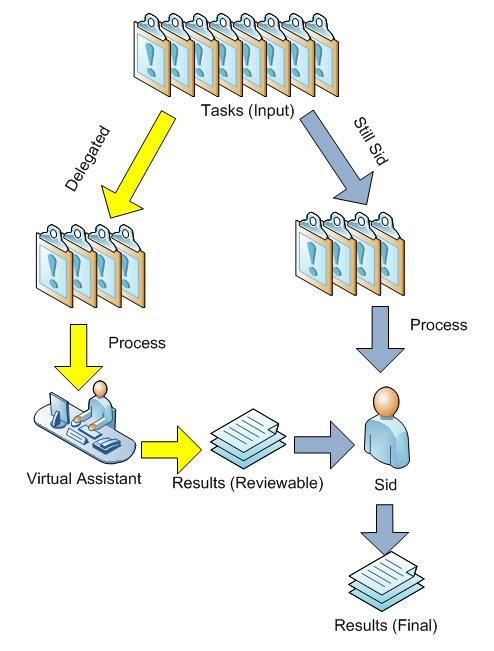
With two people, I’ve already increased my efficiency.
I still have to review the work, but it takes 5 minutes to review versus a couple of hours to do it. While the initial set up took some time and I needed to go back and forth to get the quality up to par, now that we have a smooth system set up Prabhu is executing well.
Pros:
- Consistent quality provided the tasks are well defined
- Improved efficiency for my low urgency, high priority tasks. I can take them off my task queue and hand them off
Cons:
- Doesn’t completely scale – There are still some limits on hours and availability
Life Processing with a Virtual Assistant Team
I compared a few services that provide a task based (as opposed to assistant based) solution, where each task goes into a queue and is handled by whatever assistant is available and qualified.
Now I can assign multiple tasks, and if the service has the bandwidth available, all my tasks will be worked on at the same time:
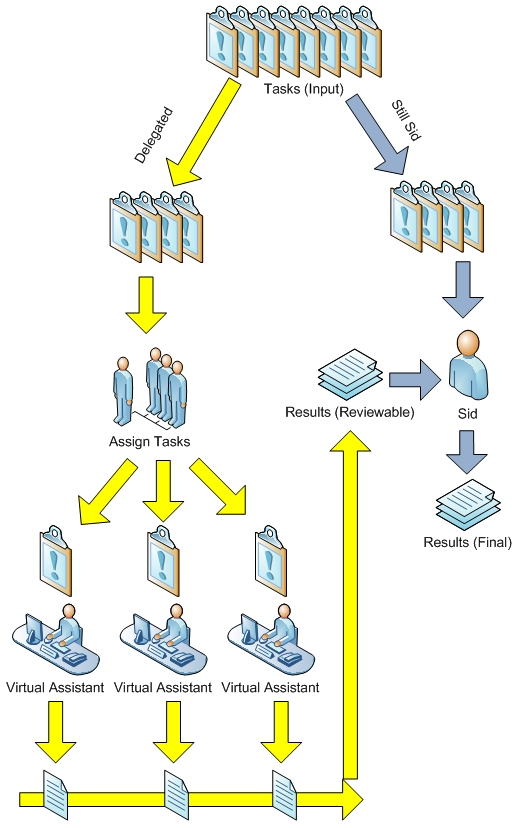
I think this new model is very interesting, and on the surface looks like it would be much more efficient than having a jack-of-all-trades type assistant, since each task can be handled by an optimized person.
How does A Team of Assistants stack up?
Pros:
- Consistent quality – again, provided the tasks are well defined
- More tasks at once With multiple people working at once, instead of 2-3 days of a single virtual assistant’s time, I had all my research back within 5 hours.
Cons:
- Additional communications channels – since I don’t know who exactly is working on a task, if I want to speak with them I have to call, have the specific aide located, and then I can contact them.
Comparison of Approaches
So, what are the main benefits of each approach?
- No assistants: The biggest benefit of having neither is simplicity. There is overhead in providing assistants enough details so that they can complete a task without your intervention, as well as reviewing their work.
- Single virtual assistant: A single assistant provides you with a consistent, loyal workforce you can depend on, such as in my case. The downside here is if your assistant is sick/unavailable, that’s too bad – unless you have a backup assistant, you likely are going to be without help until they are back to 100%. Over time, they will become more skilled to your specific needs and likely not need any retraining.
- Virtual assistant team: I think the biggest benefits of the team approach vs a single assistant are 1) the quick turnaround, 2) the multiple aides working on multiple tasks at a time and. The biggest downside is you may have to get a service, which will add overhead costs or you need to vet more people individually.
Conclusion, Recommendations
- No extra tasks, I can handle everything and/or I don’t like delegating: Don’t hire anybody.
- I have consistent repeated, reasonably skilled, easily outlined, low urgency tasks: A single virtual assistant will likely suffice.
- Varied, occasional tasks that can be very urgent and require a timely response – for this situation specifically, you might consider a team of round the clock assistants, or a local virtual (or even real life!) assistant.
While we all have different notions about what defines success and happiness, some common beliefs permeate our culture. One such belief is the ideal of the American Dream:
The American Dream is belief in the freedom that allows all citizens and residents of the United States to achieve their goals in life through hard work. Today, it often refers to one’s material prosperity…
– Wikipedia, American Dream (emphasis mine)
Society promotes the American Dream as an ideal to aspire to – the type of life that we want to live, and the type of life we wish for our children.
Let’s take a step back and ask: Will such a life of achieving one’s goals and material prosperity ultimately make us happy?
The Disconnect – Achievement and Material Possessions Do Not Make Us Happy
 Sadly, the studies don’t appear to bear this out. While it is true that raising someone from poverty to a certain level of material wealth increases happiness, the American Dream may not lead to long term happiness. Consider what Tim Kasser writes:
Existing scientific research on the value of materialism yields clear and consistent findings. People who are highly focused on materialistic values have lower personal well-being and psychological health than those who believe that materialistic pursuits are relatively unimportant. These relationships have been documented in samples of people ranging from the wealthy to the poor, from teenagers to the elderly, and from Australians to South Koreans. [Page 22] […]
Almost everyone believes that getting what you want makes you feel good about yourself and your life. Common wisdom…says that if we reach our goals, our self esteem and satisfaction with life should consequently rise… [H]owever, people who are wildly successful in their attempts to attain money and status often remain unfulfilled once they have reached their goal. […]
We may want a raise, a new car, or greater status… Yet evidence suggests that, beyond having enough money to meet our basic needs for food, shelter, and the like, attaining wealth, possessions, and status does not yield long-term increases in our happiness or well-bring. Even the successful pursuit of materialistic ideals typically turns out to be empty and unsatisfying. [Page 43] – Tim Kasser, The High Price of Materialism (emphasis mine)
What Then, Does Buy Happiness?
 What if I told you that one of the keys to our happiness is not to continue improving our own lives: but rather, to make a difference in the lives of others?
This may sound counter intuitive – and that’s ok, because in our culture, it is. As Dan Gilbert, the author of Stumbling On Happiness says:
When people give of themselves to others, and are recognized for it, they experience lots of happiness and increase in self-esteem.
Interestingly, though, we’ve just done a study that shows that when people are offered the opportunity to do something selfish or something altruistic, they take the selfish option by and large. Culture has told them this is what they should do to be happy, but if you force them to take the altruistic option, they’re much happier.
Altruism is a thing you might resist kicking and screaming—“I want to keep my money; I don’t want to give it away”—but if you give it away, it will probably make you happier than most of the things you could spend it on.
– Daniel Gilbert, interview for Shambhala Sun (emphasis mine)
Not Convinced? Further Keys to Happiness – Including Altruism
Still unsure about what makes us happy? Consider this presentation by Martin Seligman delivered at TED. At the eighteen minute mark he specifically mentions altruism as a key to happiness: when we do something fun, our happiness is fleeting, but when we are philanthropic, and help another person, that happiness lasts.
The series of various interventions you can embark on to increase your own happiness are at about the fifteen and a half minute mark. The entire presentation is wonderful, and well worth a watch if you’ve got twenty five minutes to spare.
PS – Another Presentation on Happiness, By Dan Gilbert
I first heard of Dan Gilbert through a fascinating talk he gave at TED, entitled “Why are we happy?”
I have watched the entire presentation three or four times with various friends, and we’ve always loved it. Enjoy!
]]>