This is Part 7 of 8 in The Projects AI Makes Possible, a series about building a private almanac from a 1992 geography game with a coding agent. In Part 6: AI Solved the Problem I Pointed It At. I Had Aimed Too Narrowly., testing with gameplay revealed a missing set of source data. After resolving that and successfully using the almanac for a few playthroughs, I had one final step before calling this complete: deciding what should actually make it into the product – and what to cut.
“It is only by selection, elimination, and emphasis that we get at the real meaning of things.”
Georgia O’Keeffe
By the time the almanac worked, the project behind it had become enormous. Two parallel pieces of work had grown throughout: an ever-expanding research workspace and, more slowly, the product itself.
The research workspace held extraction manifests, one-off programs to extract and reformat data, decoder experiments, groupings of images for review, various attempts at maps, a database, data review artifacts, and notes on different directions we could take. Hundreds of image files had accumulated along the way, many of them failed experiments that were still useful as evidence.
The agent had made it inexpensive to create all of that. It could build another review page, preserve another branch, or explore another feature simply because I prompted it in a direction.
In the product itself I similarly had cast a wide net to start, intermingling the almanac with the review databases, pages, and some speculative experiments. Now it was time to narrow the functionality to just what enhanced the experience while playing the game with it.
The product question was no longer what else the agent could build. It was how to whittle what we had built down to the most relevant and useful parts.
The Mess Still Had a Job
The experiments we tried explored many different directions, while the product should be intuitive and almost disappear.
Earlier, when I tested the output and compared it to what we had extracted, I wanted to be able to see everything and easily navigate from the almanac all the way to the sources and reasons for how, where and why the agent had gotten and included each piece of information. Resource IDs helped us connect files. Raw links let us inspect an extraction. Decoder galleries made it possible to compare groupings of images and recognize the one that was getting close. Review tables showed source sentences beside rewritten facts.
While iterating and researching, those artifacts helped us work together, and having a way to drill down to them from the almanac itself helped me audit, test and trace things back to their source and see them in context. The finished almanac, however, only needed them as source material. Once I trusted that the data was good, I could focus on the user experience.
What Survived the Cut
The country page gradually reduced itself to a short list:
- A flag
- A modern regional map
- A small fact box
- The rewritten country information
- Additional facts that explained searchable phrases
- Search
There were also small usability quirks we discovered in testing early iterations, which we gradually polished. Initially countries appeared in the order of their internal IDs. Pages exposed links and labels that tied back to source extraction work. Long sections pushed the search box off the screen.
These usability defects became apparent as we started playing with the almanac, and I worked with the agent to resolve them one at a time – with fixes often straightforward. Countries became alphabetical, with the capital shown before the continent. We made the sidebar collapsible to create more room for the article, and kept its reopen control on the left so it still read as a sidebar control rather than the main menu. We made the search remain visible while the page scrolled.
The search widget also improved through iteration. Pressing Enter originally jumped directly into the first match even when several results were plausible. In the finished version, the search displays multiple matching results but waits for the reader to choose. The selected result then opens the right country and moves to the exact explanation instead of dropping the reader at the top of a long page.
Those details were less technically dramatic than decoding an undocumented image format. But when we used the almanac during a game, they made the experience much more pleasant and brought it closer to the goal of becoming intuitive enough to disappear. It was also a lot of fun asking the agent to fix it as we were playing, and during the course of the case, reloading the page and seeing the changes immediately applied!
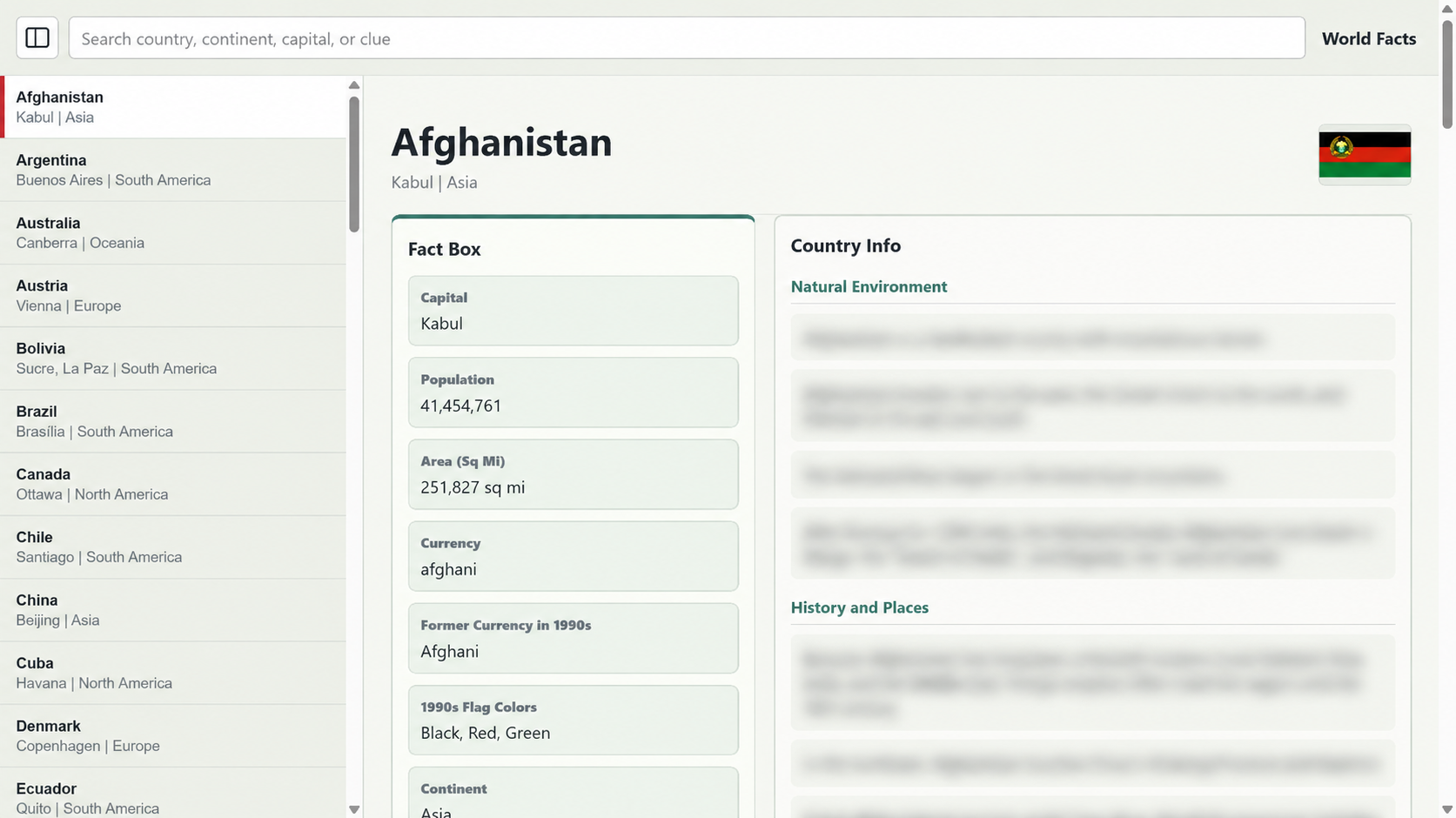
The resulting site was only about ten megabytes, and most of that was the thirteen regional map images. The facts and search material were small enough to load directly in the browser.
That meant the almanac did not need user accounts, a server-side database, or an API. Initially I thought I would deploy it as an app installed on the tablets, and perhaps in the future I will pursue that. However, the static site we built “just to test” actually performed remarkably well. It was fast, easy to cache, inexpensive to host on a local server (or one of any number of free or inexpensive web hosts), and required no personal information from the children using it.
For a bounded reference collection like this, the static site was totally serviceable as an MVP.
Some Successes Weren’t Features
For all my excitement about our breakthrough decoding the scenic images, they did not make the finished version. Recovering them had been a meaningful part of the project, and the experiments taught us how the old resource files worked. But they did not add anything to the experience, and the game already displayed them when we visited each country. We also had working background audio, but it did not improve the tablet experience enough to justify inclusion and yet another widget on the page, especially since the game itself already played it.
While that work did not make the final product, some of what we learned along the way influenced other parts of the product. The image decoder had answered a technical question and ultimately let us decode the source maps. The audio experiments proved that the old sound records could be understood.
And ultimately, the journey I took in getting to the end goal was enjoyable – unlocking parts of the data files and being able to independently load and play them was a fun reward unto itself.
The experiments and review tools were still there if I wanted to return to them. They just no longer needed to be part of the almanac we opened during a game.
]]>“You want it to be one way. But it’s the other way.”
Marlo Stanfield, The Wire
On a trip with my parents, we had a car for the day and a rough list of places we wanted to see.
Just before we left, an auntie came over and told me how nice it was to see me again. Then she smiled and said, “It’ll be fun. Let’s go outside and join your mom in the car.”
I took that to mean she was joining our trip at the last minute. I was surprised, but I did not mind.
Except every stop seemed to need her approval.
My mom would suggest somewhere, auntie would say it was too far or that another stop made more sense first, and the plan would change. It was never a big argument. The day just kept getting rearranged around what worked for her.
At a couple of stops, auntie did not even come inside with us. She stayed in the car until we were ready to go again.
My mom is always incredibly kind to our friends and family, so at first I assumed she was simply being a generous host. But after the plan changed a few times, it started to seem like we were deferring a bit too much to someone who, as far as I understood it, was just tagging along for the day.
In my head, she was a passenger with too much influence. In reality, I was the passenger.
After this happened a few times, I finally asked my mom why we were checking with auntie about every stop. I thought she was coming with us for the day.
My mom looked at me. “Sid, this is her car.”
My parents had planned to hire a car for the day, but that fell through. Auntie was already planning to go into the city, so she told them she would not mind if we joined her. She was taking us along, adjusting her route, and waiting while we made our stops.
I Had The Roles Backwards
What confused me was not the itinerary itself. It was how someone I thought was a guest had somehow become the decision-maker.
In my version of the day, my family had the plan and auntie was joining us. Of course she could have preferences. But every time my mom deferred to her, it felt like someone along for the ride had suddenly taken control of it.
Once I understood what was happening, my mom’s behavior made sense. Auntie was spending the day taking us around. Of course we were going to check what worked for her.
I Have Seen This At Work Too
The same role mismatch shows up at work. Two people can leave the same meeting each believing they own the decision, then give the team conflicting direction. Or everyone can agree on the general direction and still leave without knowing who is responsible for driving the next steps. That ambiguity can turn an ordinary disagreement into a conflict over authority, or leave a decision sitting still after an otherwise useful meeting.
DACI gives those different responsibilities names. The Driver owns the work required to get the decision made: coordinating stakeholders, gathering the necessary information, addressing open questions, and keeping the process on schedule. The Approver is the one person who makes the final call. Contributors provide expertise and recommendations, while the people who are Informed need to know the outcome because it affects their work.
When those roles are unclear, the team is working on two problems at once: the problem itself and an alignment problem about who is responsible for what. More context may improve the discussion, but it will not tell anyone who should move the decision forward or make the final call.
We need alignment on two things: what we are doing and who is responsible for deciding it.
Once the roles are clear, the conversation gets simpler. Everyone knows whether the decision is still open, what input is needed, who will make the final call, and when. People can disagree without being confused about their role in the decision.
That was the missing piece on our day trip. Everyone except me understood the arrangement. One sentence at the start would have changed how I read every conversation: “The person we planned to hire fell through, so auntie is doing us a favor letting us join her while she goes into the city today.”
With that context, I still would have had opinions about where we should go. But I would have known I was the passenger – and been grateful that auntie was letting us tag along.
]]>“The output of a manager is the output of the organizational units under his or her supervision or influence.”
Andy GroveThe main idea of High Output Management: management is output, leverage, and systems that help people do better work.
Interesting Ideas
- Meetings are a manager’s medium of work, not an interruption from work.
- Leverage matters more than busyness.
- Activity and output are easy to confuse, especially in knowledge work. You can answer messages, attend meetings, and generate updates without meaningfully changing what the team produces.
- Delegation does not erase responsibility. A manager still owns context, clarity, checkpoints, and follow-through.
- Task-relevant maturity is more useful than generic seniority. Someone can be independent in one area and need close support in another.
- Performance problems usually come down to capability, motivation, or clarity. Before blaming attitude, ask whether the person knows what good looks like, can do the work, and has a reason to care.
- Planning is only useful if it changes what you do now. The point is not to predict the future perfectly; it is to decide which current actions make tomorrow less chaotic.
- Culture is transmitted by visible behavior. People learn the real rules by watching what gets rewarded, ignored, tolerated, escalated, and repeated.
“Delegation without follow-through is abdication.”
Quotes
- “When a person is not doing his job, there can only be two reasons for it. The person either can’t do it or won’t do it; he is either not capable or not motivated. To determine which, we can employ a simple mental test: if the person’s life depended on doing the work, could he do it? If the answer is yes, that person is not motivated; if the answer is no, he is not capable.”
- “The single most important task of a manager is to elicit peak performance from his subordinates. So if two things limit high output, a manager has two ways to tackle the issue: through training and motivation.”
- “Remember that by saying ‘yes’ to projects, a course of action, or whatever – you are implicitly saying ‘no’ to something else.”
- “The art of management lies in the capacity to select from the many activities of seemingly comparable significance the one or two or three that provide leverage well beyond the others and concentrate on them.”
- “To make things work, people do not need to side with you; you only need them to commit themselves to pursue a course of action that has been decided upon.”
Related Reflections
]]>“The audience only pays attention as long as you know where you are going.”
Philip Crosby
It was a once-in-a-lifetime trip: visiting London that summer, staying in cheap hotels, and mixing leisurely enjoying the city while also trying to make the most of every moment. The sun was still up around 9 p.m., slightly disorienting as it felt more like late afternoon
As we entered the tube station, I heard a busker playing in the distance. First the unmistakeable intro, followed by the iconic opening lyrics : “Today is gonna be the day…” In retrospect, hearing one of the biggest songs by one of the biggest British bands in the world, Oasis’ Wonderwall, seems like a natural choice for buskers literally in a tube station. I could feel that moment would linger in my mind forever.
We tossed in a few coins and kept walking. After we passed, he went quiet for a few seconds, and then he started again.
I assumed he would continue the song, but he did not. He replayed the opening a second time!
At first I thought maybe he had made a mistake and just wanted to give it another go. Then, while we were waiting for the tube, we heard him restart and play the opening again. This time, we laughed because we had a suspicion that he knew what he was doing.
The Part That Mattered
His audience was not sitting in a theater.
They were tourists walking through a station, carrying bags, watching signs, looking for the right platform, trying not to miss the next train. Most had only a few seconds to notice him, and in those few seconds, the part of the song everyone knew was the part that mattered.
He was giving people what they wanted.
He was giving people what they wanted.
If people had stopped to listen, maybe the right thing would have been to play the whole song. But for people passing by, the best version of the work was short, familiar, and timed to the situation.
Respecting The Moment
I think about that busker more often than I would have expected.
Partly because it was funny. Partly because it was a tiny bit brilliant. He was not trying to prove he knew the whole song. He was not asking the room to become something it was not. He noticed the moment he was in and played the part that would actually reach people.
In a few seconds, you recognized the hook, you recognized the lyrics, dropped your coins in his case – and enjoyed those few moments on your way to the next part of your travels. And after you had passed, it would be time for a new group of people to hear the same thing, and have their own moment.
At Present
I wrote this years ago as a small travel story, but I think about it now most often in engineering leadership.
There are times when I want to give the whole explanation: the context, the constraints, the tradeoffs, the history of how we got here, and why the obvious answer is not actually obvious. Sometimes that is exactly what the moment needs. If the group is deep in the work and trying to make the right call, the details matter.
But if the goal is alignment, the moment may need something different. People may need the decision, the risk, the cost of waiting, the tradeoff, and the ask. A project update, a planning conversation, a business case, or a hard change in direction can fail not because the reasoning was weak, but because the useful part never became clear enough for the room to act on.
That does not mean dumbing it down. It means respecting the room you are in. Sometimes communication is not complete when I have said everything I know. It is complete when the other person has what they need for the decision in front of them.
“Time is the coin of your life.
It is the only coin you have, and only you can determine how it will be spent.
Be careful lest you let other people spend it for you.”
– Carl Sandburg
Each week, I put money aside for savings, investments, bills, and the other things I know I need to take care of before I spend the rest.
If there is not enough for everything, I cut back somewhere. Maybe I spend less on something nice but unnecessary. Maybe I wait on a purchase. But the important part is that I do not wait until the end and hope there is something left.
I pay myself first.
I have not always treated my time that way.
For a long time, I would wake up and start spending the day on whatever was already waiting for me. Client work. Email. A project. A favor for a friend. Something that felt useful, responsible, and easy to justify.
Only after those things were handled would I try to make room for my own goals.
In theory, that sounded fine. I had scheduled time for myself later. I had a plan. But then the work would pile up, or the day would run long, or I would finally get to the evening and feel too drained to do the thing I said mattered to me.
Some days I would make it to my goals. Plenty of days I would not.
That bothered me, because I was not neglecting random things. I was neglecting things I said were important: exercise, reading, reflection, personal projects, and the quiet work of becoming the kind of person I wanted to become.
Paying Myself Last
The uncomfortable pattern was that other people’s priorities got my best energy, and my own priorities got whatever was left.
I do not mean that in a resentful way. Work matters. Commitments matter. Being useful to other people matters. I am not trying to build a life where I only do what I feel like doing.
But there is a difference between serving real commitments and letting the day decide for me. If I always started with whatever was most urgent, easiest to answer, or most visible to someone else, I should not have been surprised when my own goals kept moving to tomorrow.
So I started experimenting with a simple change: I moved some of the things that mattered to me earlier in the day.
Not everything. Not some heroic three-hour morning routine. Just enough to stop treating my own life as something I would get to after the real work was done.
Before The Day Starts Spending Me
For me, mornings became the easiest place to protect that time.
The house is quieter. Fewer people are asking for things. I have not yet opened the door to email, messages, news, and the small emergencies that can make a day feel already claimed.
So I use that time for the things I am most likely to lose later. I work out. I read. Some days I practice guitar. Some days I reflect, or work on a personal project before the rest of the world has had a chance to pull my attention somewhere else.
The point is not that everyone needs to wake up early. Some people do better at night. Some seasons of life make mornings unrealistic. Kids, health, work schedules, and family responsibilities can all change what is possible.
The point is that the things that matter most need protected time somewhere.
If they only get the scraps, they usually get squeezed out.
Removing The Daily Negotiation
One thing I like about doing my personal priorities earlier is that it removes a negotiation I am very good at losing.
If I tell myself I will exercise later, then later has to compete with fatigue, errands, messages, dinner plans, and whatever happened during the day. By then, skipping can sound reasonable. I can always start again tomorrow.
But if I do it early, I do not have to keep deciding all day whether it still matters. It is already done. The day can get messy afterward, and at least one promise to myself has survived.
That has been the bigger benefit for me. It is not just productivity. It is trust. I trust myself more when the things I say matter show up somewhere real on the calendar.
Even a small amount of time can change the feel of the day. Ten minutes reading. A short walk. A few pages of notes. A workout. A little work on a personal project that keeps getting postponed.
It does not have to be impressive to count.
A Little Time, First
I still think about this as paying myself first with time.
Not because my needs are the only ones that matter, and not because every morning has to be optimized into some perfect ritual. More because I know what happens when I assume I will get to the important personal things later.
Later is where good intentions go when they do not have a place to live.
So when I can, I try to give the first clean part of the day to something I want my life to be built around. Health. Learning. Reflection. A personal project. Sometimes just a few quiet minutes before the rest of the day begins.
I do not always get it right. But I have found that when I protect even a little time for myself before the day starts spending me, the whole day feels different.
]]>