But…did this study really happen? Let’s find out
Just Like Hiring My Own Research Staff – Google Book Search
As I mentioned in that past article, the study is sourced from the book What They Don’t Teach You in the Harvard Business School, by Mark McCormack.
I was curious, and searched for the actual study online, but was unable to find it.
It Isn’t True Just Because The Internet Said So – Or Books Either, Apparently
I had read the study was conducted at Harvard, and thus when researching, I searched for “Harvard written goals study.”
I have since learned that sometimes the study references a Harvard class of 1979, and sometimes a Yale class of 1953.
I went researched on Google Book Search and found additional references to such a Yale study. The premise and results were always the same. Either this was a reproducible experiment… or something was a little fishy.
On Google Answers, I found someone had offered $20 in 2004 for a study showing the effects of writing down a goal on its achievement.
The question was never answered, though a passing reference was made to the Harvard and Yale studies being myths.
While it was hard to find the study or proof that it happened, I wanted further confirmation – and I got it.
From The Horse’s Mouth: Yale Says There Is No 1953 Goal Setting Study
I finally came across a page at the Yale Law Library that asks “Where can I find the Yale study from 1953 about goal-setting?“. The answer, in it’s entirety:
It has been determined that no “goals study” of the Class of 1953 actually occurred. In recent years, we have received a number of requests for information on a reported study based on a survey administered to the Class of 1953 in their senior year and a follow-up study conducted ten years later. This study has been described as how one’s goals at graduation related to success and annual incomes achieved during the period.
The secretary of the Class of 1953, who had served in that capacity for many years, did not know of [the study], nor did any of the fellow class members he questioned. In addition, a number of Yale administrators were consulted and the records of various offices were examined in an effort to document the reported study. There was no relevant record, nor did anyone recall the purported study of the Class of 1953, or any other class.
(Source : Where can I find the Yale study from 1953 about goal-setting?)
So it appeared that my urging people to write down their goals was based on a study that never happened. Fortunately, I stumbled across something else quite interesting while researching the validity of the Yale and/or Harvard study.
Among the results of my online research for this article, I came across an actual study done with results received from 149 participants.
They too believe the story of the Harvard/Yale study to be a myth – and thus conducted a study of their own! The results of the study:
The positive effect of written goals was supported: Those who wrote their goals accomplished significantly more than those who did not write their goals.
[…]
- This study provides empirical evidence for the effectiveness of three coaching tools: accountability, commitment and writing down one’s goals.
- There now is a study demonstrating that writing one’s goal enhances goal achievement. However, it was not done at Harvard or Yale, but at Dominican University.
(Source: Summary of Recent Goals Research(PDF here: Gail Matthews Written Goal Study Dominican University), by Gail Matthews, Ph.D., Dominican University)
Note: the original links I had for this article keep moving, so I am now hosting a copy of the PDF since the links appear to break every couple weeks.
The moral of the story: Don’t believe everything you read online. Nonetheless, the initial advice is still sound – write down your goals!
]]>I also reviewed a team of virtual assistants, and compare my single virtual assistant versus a team of assistants with task based processing.
The Experiment
I know some of the day to day tasks I do online suck up a lot of my time. I have automated some of these tasks, such as automatic email filtering, and streamlined other processes such as how I read blogs. I decided to try an experiment with a virtual assistant, to see if I could effectively outsource parts of my digital life. I also compared my solo virtual assistant to a professionally managed, concierge style virtual assistant team.
What I expected
I imagined I would be able to save some time with a virtual assistant. Further, I hypothesized that the team would do a better job than my solo assistant – but would be more expensive, and it would end up being a decision based on value provided.
A Normal Sid Life Processing Flow
Before we get to comparing the virtual assistants, let’s set up the base task processing workflow. I am one person, I have a list of tasks to do, and I do them:
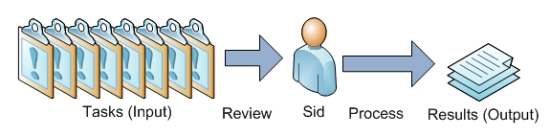
Of course, we can see where the bottleneck is here: Sid.
Pros:
- Consistent quality
- Simple organization hierarchy – Single point of contact
- Task progress constantly updated and available
Cons:
- Doesn’t scale
- Single point of failure
Sid Life Processing with One Virtual Assistant
To remove the bottleneck in the process above I add a second person and delegate some tasks to them.
In this case, some of the tasks I have been delegating are:
- Researching various items for me in spreadsheets
- Summarizing data
In the new workflow, yellow arrows show processes the virtual assistant is handling, and blue show processes Sid is handling:
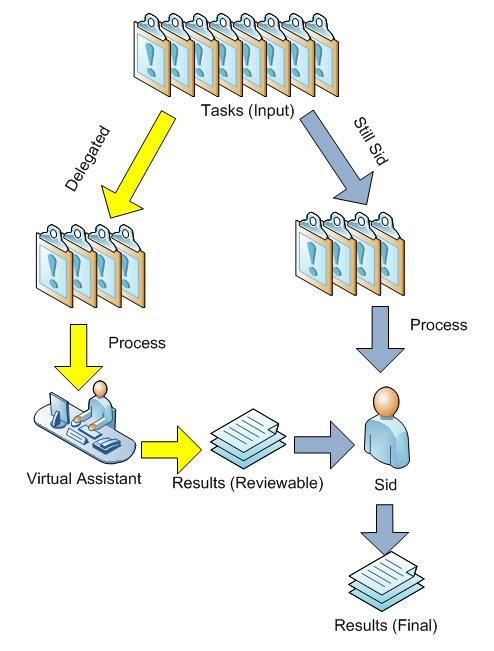
With two people, I’ve already increased my efficiency.
I still have to review the work, but it takes 5 minutes to review versus a couple of hours to do it. While the initial set up took some time and I needed to go back and forth to get the quality up to par, now that we have a smooth system set up Prabhu is executing well.
Pros:
- Consistent quality provided the tasks are well defined
- Improved efficiency for my low urgency, high priority tasks. I can take them off my task queue and hand them off
Cons:
- Doesn’t completely scale – There are still some limits on hours and availability
Life Processing with a Virtual Assistant Team
I compared a few services that provide a task based (as opposed to assistant based) solution, where each task goes into a queue and is handled by whatever assistant is available and qualified.
Now I can assign multiple tasks, and if the service has the bandwidth available, all my tasks will be worked on at the same time:
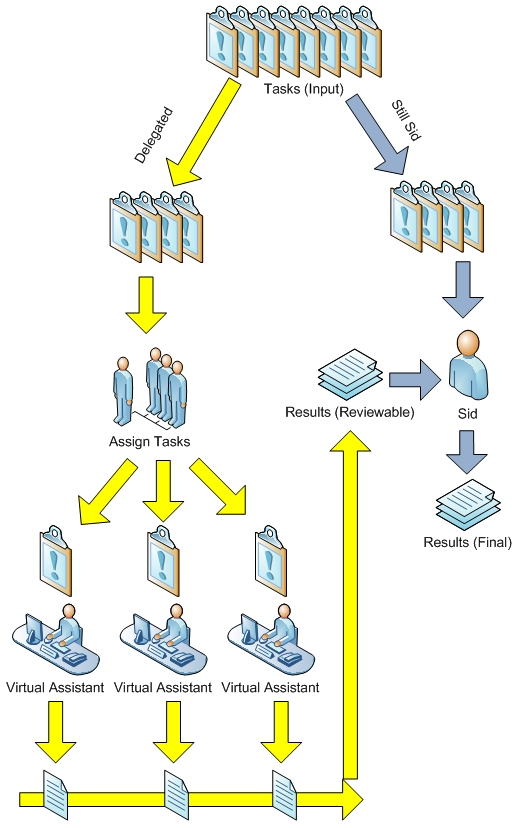
I think this new model is very interesting, and on the surface looks like it would be much more efficient than having a jack-of-all-trades type assistant, since each task can be handled by an optimized person.
How does A Team of Assistants stack up?
Pros:
- Consistent quality – again, provided the tasks are well defined
- More tasks at once With multiple people working at once, instead of 2-3 days of a single virtual assistant’s time, I had all my research back within 5 hours.
Cons:
- Additional communications channels – since I don’t know who exactly is working on a task, if I want to speak with them I have to call, have the specific aide located, and then I can contact them.
Comparison of Approaches
So, what are the main benefits of each approach?
- No assistants: The biggest benefit of having neither is simplicity. There is overhead in providing assistants enough details so that they can complete a task without your intervention, as well as reviewing their work.
- Single virtual assistant: A single assistant provides you with a consistent, loyal workforce you can depend on, such as in my case. The downside here is if your assistant is sick/unavailable, that’s too bad – unless you have a backup assistant, you likely are going to be without help until they are back to 100%. Over time, they will become more skilled to your specific needs and likely not need any retraining.
- Virtual assistant team: I think the biggest benefits of the team approach vs a single assistant are 1) the quick turnaround, 2) the multiple aides working on multiple tasks at a time and. The biggest downside is you may have to get a service, which will add overhead costs or you need to vet more people individually.
Conclusion, Recommendations
- No extra tasks, I can handle everything and/or I don’t like delegating: Don’t hire anybody.
- I have consistent repeated, reasonably skilled, easily outlined, low urgency tasks: A single virtual assistant will likely suffice.
- Varied, occasional tasks that can be very urgent and require a timely response – for this situation specifically, you might consider a team of round the clock assistants, or a local virtual (or even real life!) assistant.
While we all have different notions about what defines success and happiness, some common beliefs permeate our culture. One such belief is the ideal of the American Dream:
The American Dream is belief in the freedom that allows all citizens and residents of the United States to achieve their goals in life through hard work. Today, it often refers to one’s material prosperity…
– Wikipedia, American Dream (emphasis mine)
Society promotes the American Dream as an ideal to aspire to – the type of life that we want to live, and the type of life we wish for our children.
Let’s take a step back and ask: Will such a life of achieving one’s goals and material prosperity ultimately make us happy?
The Disconnect – Achievement and Material Possessions Do Not Make Us Happy
 Sadly, the studies don’t appear to bear this out. While it is true that raising someone from poverty to a certain level of material wealth increases happiness, the American Dream may not lead to long term happiness. Consider what Tim Kasser writes:
Existing scientific research on the value of materialism yields clear and consistent findings. People who are highly focused on materialistic values have lower personal well-being and psychological health than those who believe that materialistic pursuits are relatively unimportant. These relationships have been documented in samples of people ranging from the wealthy to the poor, from teenagers to the elderly, and from Australians to South Koreans. [Page 22] […]
Almost everyone believes that getting what you want makes you feel good about yourself and your life. Common wisdom…says that if we reach our goals, our self esteem and satisfaction with life should consequently rise… [H]owever, people who are wildly successful in their attempts to attain money and status often remain unfulfilled once they have reached their goal. […]
We may want a raise, a new car, or greater status… Yet evidence suggests that, beyond having enough money to meet our basic needs for food, shelter, and the like, attaining wealth, possessions, and status does not yield long-term increases in our happiness or well-bring. Even the successful pursuit of materialistic ideals typically turns out to be empty and unsatisfying. [Page 43] – Tim Kasser, The High Price of Materialism (emphasis mine)
What Then, Does Buy Happiness?
 What if I told you that one of the keys to our happiness is not to continue improving our own lives: but rather, to make a difference in the lives of others?
This may sound counter intuitive – and that’s ok, because in our culture, it is. As Dan Gilbert, the author of Stumbling On Happiness says:
When people give of themselves to others, and are recognized for it, they experience lots of happiness and increase in self-esteem.
Interestingly, though, we’ve just done a study that shows that when people are offered the opportunity to do something selfish or something altruistic, they take the selfish option by and large. Culture has told them this is what they should do to be happy, but if you force them to take the altruistic option, they’re much happier.
Altruism is a thing you might resist kicking and screaming—“I want to keep my money; I don’t want to give it away”—but if you give it away, it will probably make you happier than most of the things you could spend it on.
– Daniel Gilbert, interview for Shambhala Sun (emphasis mine)
Not Convinced? Further Keys to Happiness – Including Altruism
Still unsure about what makes us happy? Consider this presentation by Martin Seligman delivered at TED. At the eighteen minute mark he specifically mentions altruism as a key to happiness: when we do something fun, our happiness is fleeting, but when we are philanthropic, and help another person, that happiness lasts.
The series of various interventions you can embark on to increase your own happiness are at about the fifteen and a half minute mark. The entire presentation is wonderful, and well worth a watch if you’ve got twenty five minutes to spare.
PS – Another Presentation on Happiness, By Dan Gilbert
I first heard of Dan Gilbert through a fascinating talk he gave at TED, entitled “Why are we happy?”
I have watched the entire presentation three or four times with various friends, and we’ve always loved it. Enjoy!
]]>In Dynasty mode, you coach a college football program through multiple seasons and you can only improve your team long term by mastering the recruitment process.
NCAA Football 09 Dynasty Mode Recruitment Rules
The relevant rules for recruitment:
 Recruit enough players to play each position, or you will have to choose a walk-on from your college class
 - You have 25 scholarships to hand out and 35 slots on your recruitment board
- You have 10 “hours” a week to recruit (in real life, this takes about 3 minutes).
- The computer will spend any leftover time recruiting players on your behalf
- Players will rank aspects of each school based on how good they perceive it to be and how important it is to them. Their perceptions will affect how easy/hard it is to recruit that particular player.

Life Lessons – Goal Setting, Prioritizing, and Persistence
 As I got better at NCAA Football 09, I’ve noticed that my strategy based on the various rules hold broader lessons for my life.
Lesson #1: If you don’t go after what you want, you won’t get it. Spend your time chasing what you really want.
Example: Automatic CPU Recruitment – The first season I played, I didn’t want to do any recruiting. I spent none of my 10 hours per week, the CPU automatically recruited for me. At the end of the year I looked at my new players and what did I have? Garbage. The players were terrible and the computer didn’t pay any attention to how the players would fare in my lineup down the road.
Real Life: Life happens to all of us sixty seconds at a time, whether we are ready for it or not. Make the most of your time, and make sure you choose how you spend it – going after what you desire, or you’ll just get the scraps that happen to fall your way. I’m reminded of this quote:
“Your time is limited, so don’t waste it living someone else’s life. Don’t be trapped by dogma – which is living with the results of other people’s thinking. Don’t let the noise of other’s opinions drown out your own inner voice. And most important, have the courage to follow your heart and intuition. They somehow already know what you truly want to become. Everything else is secondary.” – Steve Jobs (emphasis mine)
Lesson #2: Recruit and fill the roles you must with what you want, or they will be filled for you.
Example: Walk Ons – After I stopped letting the CPU control my recruitment, I recruited for everything but one particular position: center. I ignored it and had a walk-on fill the gap. This turned out to be a disaster. While the average player on my team was a 65 or 70 (on a scale from 40-100), my walk-on was in the high 40s and useless.
Real Life: I have always tried very hard to find jobs and companies that challenge me and that further my career. If I hadn’t made a conscious decision to do this, I am sure I would have taken any job that came my way that paid the bills. I also try to surround myself with friends who are intelligent, interested in fitness and health, and successful – if I don’t make a conscious effort to surround myself with quality people, I’ll just take whoever I can get. Every day we can make a choice: do we fill our lives with what we want, or will we just accept whatever life provides us?
Lesson #3: Play to your strengths – know what you are good at, and where your advantage lies.
Example: Recruiting Players: Their Priorities versus My Program – I noticed that some of the players I recruited were a better fit than others (e.g., my Athletic Facilities were Excellent, and it was their Most important criteria). These player were an easy sale and generally ended up signing with me. For other players, their athletic facilities interest might be “Average” – they were interested, but it wasn’t their top criteria, no matter how good my facilities were. These were much tougher sells, and occasionally I could swing them, but it wasn’t easy.
Real Life: I’ve learned that I have an easier time achieving goals and getting things that are in line with my strengths. I experienced this firsthand when trying to get my first real job. When I finished college, I wanted to develop software. My strongest competency was Java development, but I was hungry to develop any software database work, software in other languages (C++, Python, Perl). I was pretty good all around, but I had a hard time convincing managers to hire me – they always found someone that was better than me for that specific position, with the specific skills they wanted. I finally landed a job at DirecTV, and developed other skills, but furthered my Java software development skills. My next two jobs since then? Both heavily Java based, and both relatively easy to get.
Lesson #4: Just because you can chase a large number of opportunities doesn’t mean you should.
Example: Recruitment Board Slots – When I started recruiting, I noticed I had 35 slots. I immediately filled all 35 with players I wanted and tried to recruit as many of them as I could. With only 10 hours a week, however, I was spending less than 20 minutes a week on each player. I would later learn that realistically, it takes between 1 and 2 hours a week consistently to recruit a quality player. Unable to spend a sufficient amount of time on any of the players, you can guess what happened – I often didn’t get most of them. I had to prioritize, and as I’ve gotten better, I now typically only recruit about 8-10 quality players a year at any given time.
Real Life: We can do anything we want in life, but we can’t do everything we want all at once. I used to have a large todo list – not anymore. Since implementing the system outlined in Getting Things Done, I now have a “Someday” bucket. While I have many items on the backburner, at any given time I keep my commitments and priorities to the most essential – everything else, I let it slide.
Lesson #5: It won’t come easy, but if you set your mind to it, you can usually get what you truly desire.
Example: Recruiting Poorly Matched, But Desired Players – Sometimes, all I want is a good quarterback – but there are no quality quarterbacks available that want to play for me. I learned that while I couldn’t recruit the one quarterback I wanted with just an hour every week, I could if I spent 2-3 hours a week. One year I spent one third of my whole season’s recruiting time, every week, on a single player – a running back that was faster than anybody else. My persistence paid off, and the last week of the season, he finally signed on. He was the cornerstone of my team for the next four years.
Real Life: If you want it bad enough, sure you can have it – but you need to put in the effort- and perhaps make some sacrifices. My freshmen year in college I was skinny and tired of it. I am an ectomorph (translation: people with my body have difficulty gaining large amounts of muscle), but in spite of the disadvantage I started out with, I wanted to improve my physical appearance and bulk up. I made my workouts a priority (including the days of final exams), ate lots of food, drank 6-8 glasses of chocolate milk a day and slept 8-10 hours a night consistently. My commitment paid off, as I gained more muscle, about 40 lbs, in a shorter time frame than I ever have since.
Lesson #6: It ain’t over till it’s over.
Example: Recruiting Players That Have Already “Committed” – In NCAA 09, there are two types of commits – a soft commit and a hard commit. A hard commit means the player has signed and there’s no turning back – he’s playing for your team. A soft commit on the other hand signals that a player has made up his mind, and is about to commit to a team – but there’s still a chance they can change their mind. Whenever a player has a soft commit to another team, if I really want them, I recruit them hard that week. If they stay as a soft commit, I keep hammering on them – and about half the time, I can swing them to a soft commit to me, and then a hard commit to me.
Real Life: It’s almost never really over, and a client/hiring manager/etc saying no is only a temporary setback – the equivalent a soft commit. As an undergraduate in college, I wanted to run for student government. I inquired in September, but they told me elections are held at the end of each school year, in April/May, and to come back next year. One day I noticed they had put a small sign in the window about special elections. I learned that because some senators had dropped out, I could run for office and complete their term. I won, entered the senate, and had the opportunity to serve a year longer than I would have if I had just thrown in the towel the first time they told me no.
Life Lessons from Unusual Places
Some of the ways I often learn things is through books, my favorite blogs and of course my parents – the older I get, the smarter they are! Just like this example though, I’m sure many of you have learned things in non-traditional areas, that have carried broader lessons in your life.
What video games do you enjoy? Are there unusual ways/places/experiences that have shaped your life? Or any life lessons you’ve learned from people in your life you’d like to share? I’d love to hear from you in the comments.
]]>“Easy question” I thought to myself, as my fingers flew to the keyboard and I rattled off 10 books, then 20. I could have gone on, but I stopped.
More Items Does Not Make the List Better
I took a step back, and realized that my reader didn’t need yet another long lists of books – there are plenty of those online, and if you want an endless list of reading material, check out this list of all the self improvement products at Amazon (1,140 at last count).
No – she was asking for my help, to sort through it all. The more items I gave her, the less helpful I would be.
A better approach would be to give her a list that provided the best value – a list of the best personal development books, and the shorter better.
This was a much more difficult problem. After much reflection, here is my list.
The Best Personal Development Books Reading List – A Practical, Short List
Let’s get right to it – I’ll lay out the list for you, and then explain each of my choices.
- The Greatest Salesman in the World by Og Mandino
- How To Win Friends and Influence People by Dale Carnegie
- Getting Things Done (GTD) by David Allen
The Best Personal Development Books Reading List Explained
The Greatest Salesman in the World
 This book is the perfect place to begin. The “scrolls” (self affirmations/positive self talk) at the end are what make this book worthwhile. As recommended, I read each one to myself 3 times a day for a month. I now read them at least once a day and alternate the scrolls each week. The main purposes of this book are to:
- Instill the discipline to stick to the process daily.
- Provide a starting point for future personal development with broadly applicable lessons.
- Show tangible results.
How To Win Friends and Influence People
 Once the you’ve had a taste of personal development, and developed the habit of committing to it daily by following The Greatest Salesman in the World, it’s time to start working on interpersonal skills, for a few reasons. The primary things I gained from this book are:
- Effective Conflict Resolution
- Breaking down social interactions into patterns
- Leadership Training
Getting Things Done (GTD)
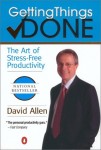 GTD will not provide you more time to do things, but it will keep all the machinery focused and moving forward. The main results gained from Getting Things Done are:
- Clearing your head so you can focus
- Never lose anything again
- Know that you are doing exactly what you are supposed to be doing